
In this article:
- How common is off-target binding, really?
- Does polyspecificity persist into late-stage clinical development?
- Why can’t you predict off-targets from sequence analysis alone?
- What is TCR missing?
This article is part 5 of a series about specificity testing. Be sure to read part 3, about the limitations of tissue cross-reactivity studies.
Summary
Off-target binding in antibody therapeutics is far more common than most people expect. Our analysis of hundreds of antibody-based drug candidates found that roughly 1 in 3 lead candidates display polyspecific off-target binding. And the problem persists as drugs advance through development. Even among FDA-approved MAbs, about 15% show off-target binding. Side-by-side comparisons of MPA and tissue cross-reactivity (TCR) data reveal that many of these off-targets went undetected by traditional methods. Spotting these interactions early, and identifying the specific off-target proteins, is the first step toward addressing them.
How common is off-target binding, really?
In an earlier article, we mentioned that 1 in 3 antibody lead candidates has off-target binding. Here, we’ll dig into that number.
To quantify the prevalence of polyspecificity across the industry, we conducted a retrospective analysis of all antibody-based therapeutics submitted by customers for specificity testing on the Membrane Proteome Array (MPA) over a defined time period. We analyzed 254 samples in total, including MAbs, scFv-Fcs, and VHH-Fcs. These samples primarily represent lead candidates at biopharmaceutical companies throughout the industry. To be included in the analysis, each sample had to have successfully completed all three steps of the MPA process: Assay Setup, MPA Screen, and Validation (Norden et al., 2024).
The results were striking:
- 83 of 254 samples (32.7%) displayed polyspecific off-target binding.
- Among the polyspecific antibodies, about half had a single off-target, while the rest had two or more.
- Off-target binding was almost always to completely unpredictable membrane proteins with no significant sequence homology to the intended target.
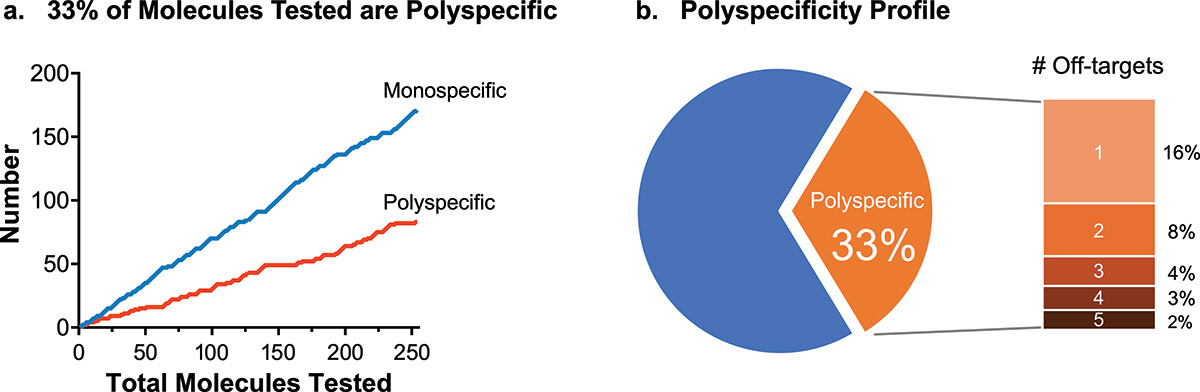
33% of 254 antibody-based lead candidates screened on the MPA demonstrated validated off-target binding. Data from Norden et al., 2024.
The 33% figure reflects true, confirmed off-target binding interactions. Off-target binding was detected during MPA screening on ~6,000 native membrane proteins, then validated by antibody titration studies to confirm each hit. Note that these results include only CDR-mediated interactions. Non-CDR-mediated interactions, such as binding to Fc receptors or lectins, would push the off-target rate even higher if counted.
Perhaps most importantly, the off-targets were almost never related to the intended targets. In part, that’s because most MAbs screened on the MPA have already been tested against members of the same protein family. The study results represent genuinely unexpected interactions that conventional approaches would miss entirely.
The findings support our recommendation to conduct specificity testing using cell-based protein arrays early in drug development, ideally during lead selection, when potential toxicity issues can be identified and addressed with relatively little impact on a drug program.
Does polyspecificity persist into late-stage development?
Given the high off-target rate among lead candidates, we wanted to know whether polyspecificity persists among MAbs that have gone into humans. To find out, we produced biosimilars of 83 clinical-stage, FDA-approved, and withdrawn MAbs and screened them on the Membrane Proteome Array (MPA).
The answer is yes: polyspecificity persists at every stage of clinical development.
- 18.1% of clinical MAbs overall showed off-target binding.
- Off-target rates were slightly higher for withdrawn MAbs (22.2%) and those in Phase 2/3 (20.0%) compared to approved MAbs (15.0%).
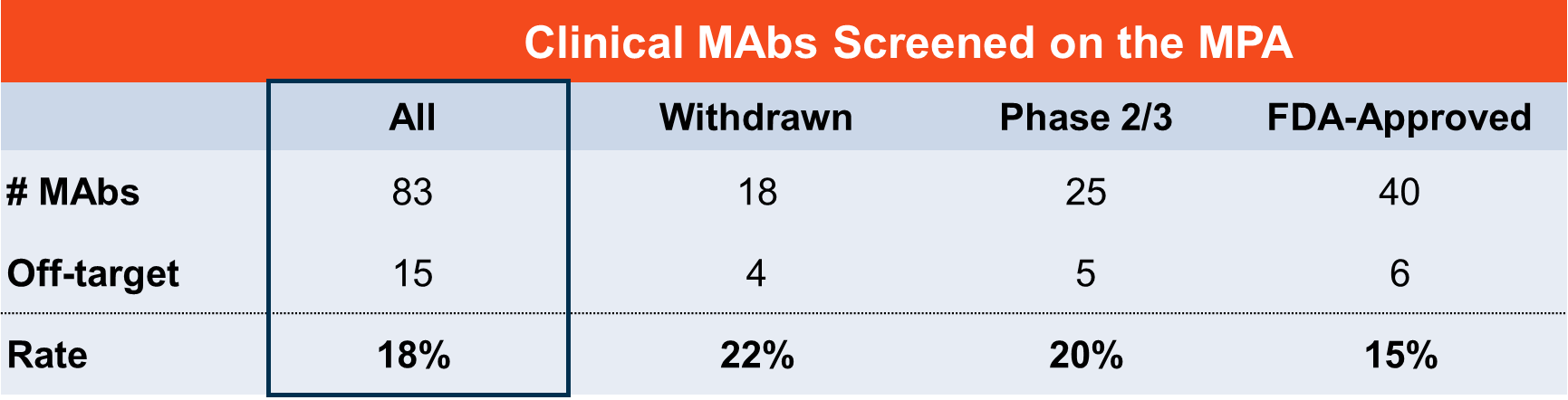
Off-target binding was found in MAbs at all stages of clinical development, with higher rates among withdrawn and clinical-stage MAbs than approved ones. Based on Norden et al., 2024.
The lower rate among clinical-stage MAbs compared to lead candidates (18% vs. 33%) suggests that polyspecificity contributes to drug attrition; candidates with off-target binding appear to drop out of the pipeline at higher rates. But an off-target binding rate of 15% in FDA-approved drugs makes clear that current screening methods are not catching everything.
An independent analysis published in 2026 reached a similar conclusion. Dai et al. used a different platform to screen 174 FDA-approved and clinical-stage MAbs against 6,172 human extracellular proteins, finding that 28% had at least one off-target. The Dai et al. and Norden et al. studies used different technologies and somewhat different protein sets, but both point to the same conclusion: off-target binding among clinical antibodies is not rare, and it is not an artifact of any single platform.
Why can’t you predict off-target binding from sequence analysis alone?
One of the most consistent findings across our Membrane Proteome Array (MPA) data is that off-target binding is almost never to a related protein. So why is it happening?
Three mechanisms have been identified:
Molecular mimicry is likely the most common. Critical epitope residues in the intended target are mirrored, by chance, in a completely unrelated protein. In one well-documented example, a MAb we isolated against the glucose transporter SLC2A4 (GLUT4) also bound to Notch1, a signaling protein with less than 7% sequence identity and no structural similarity to GLUT4. Epitope mapping traced the cross-reactivity to a shared LGXXGP motif present in both proteins: one in a loop on GLUT4, the other in a disulfide-constrained loop on Notch1 (Tucker et al., 2018).
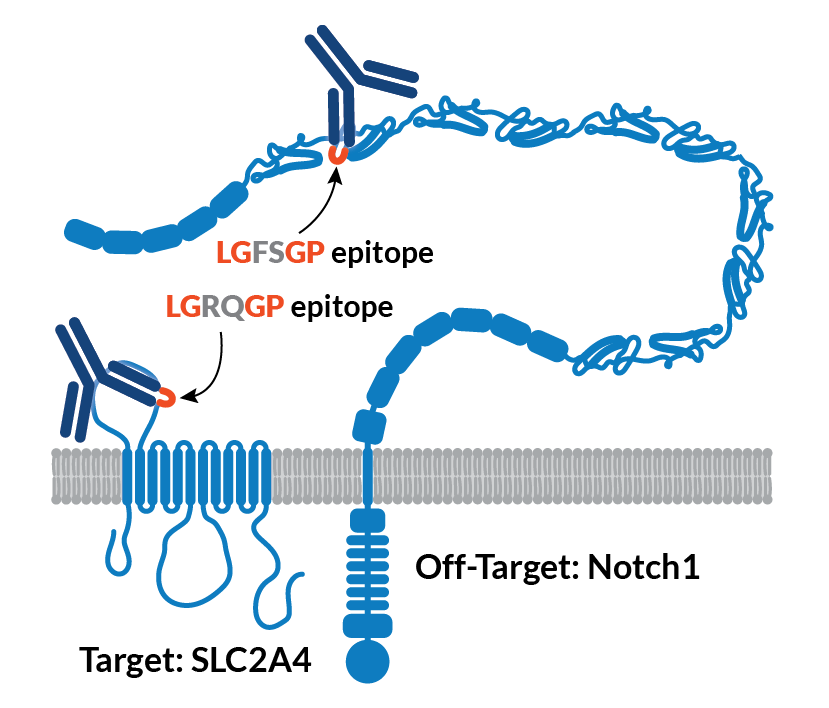
Molecular mimicry explains how a MAb against SLC2A4 (GLUT4) also bound Notch1—despite less than 7% sequence identity. Epitope mapping revealed that both proteins share an LGXXGP epitope motif. Graphic based on Norden et al., 2024, Fig. 6.
CDR plasticity is a second mechanism, in which conformational flexibility in the antibody’s complementarity-determining regions (CDRs) allows the paratope to adapt to more than one antigen.
Differential CDR engagement is a third possibility: off-target binding may occur through entirely different CDR residues than those used to bind the primary target.
The practical implication is the same regardless of mechanism: off-target binding cannot be reliably predicted from sequence or structural analysis. Proteome-wide empirical screening is the only reliable way to detect it.
What is TCR missing?
As discussed in an earlier article, tissue cross-reactivity (TCR) studies have significant limitations. Our own data provides direct evidence of one of the most consequential: TCR is missing off-target interactions that the Membrane Proteome Array (MPA) detects.
To compare the two approaches, we reproduced FDA-approved MAbs and screened them on the MPA, then compared our results to TCR data from the corresponding biologics license applications (BLAs). In several cases, the MPA identified off-target binding that was not mentioned in the TCR summaries.
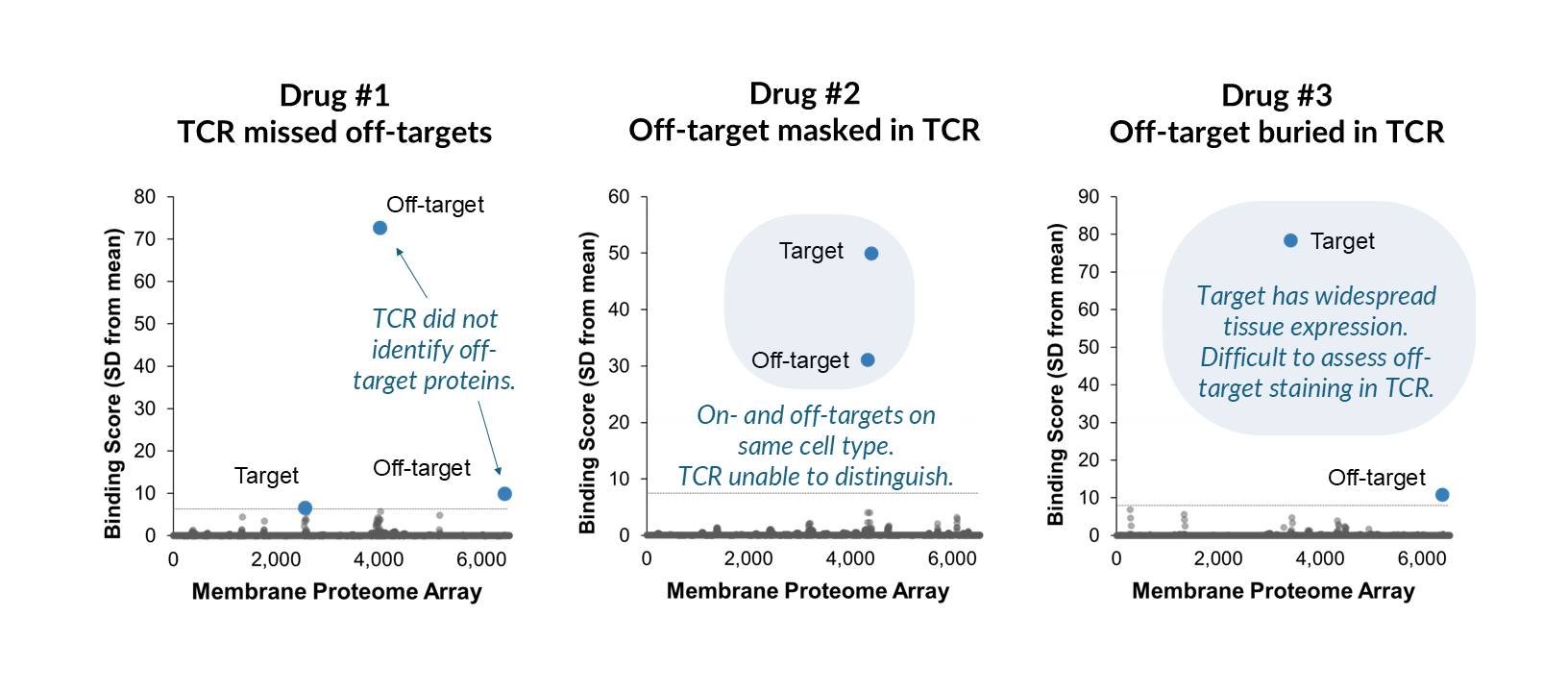
In three side-by-side comparisons, MPA screening of biosimilars of FDA-approved MAbs identified off-targets that were not detected or reported in available TCR data from BLA applications. Dotted line represents 3 SD above calculated background. Adapted from Norden et al., 2024.
Three examples illustrate the pattern:
- Case Study 1. This antibody targets a plasma membrane protein expressed on lymphocytes. The MPA correctly identified the intended target—and also detected two off-target membrane proteins that bound even more strongly than the target. The BLA summary indicated TCR staining consistent with known target expression on lymphocytes, with no off-target binding reported.
- Case Study 2. This antibody targets a membrane protein expressed on the plasma membrane and intracellularly in myeloid cells. The MPA identified the target and an additional off-target expressed on the same cell type. The BLA summary noted staining consistent with known target expression and did not mention off-target binding. When the target and off-target are co-expressed on the same cell, tissue-based methods cannot distinguish between them.
- Case Study 3. This antibody targets a membrane protein with low, widespread expression across most normal tissues that is upregulated in certain disease states. The MPA identified the target and an off-target membrane protein. The BLA summary reported primarily cytoplasmic staining across many tissues, with no significant off-target concerns—likely because identifying an off-target signal against a background of widespread positive staining is extremely difficult using TCR.
In none of these cases were the off-targets members of the same protein family as the intended target. These represent genuinely unexpected interactions that TCR was not designed to detect.
Looking ahead
The data clearly show that off-target binding is a widespread problem that traditional methods are failing to catch. But what actually happens when those interactions go undetected—and make it into the clinic? In the next article, we examine case studies where undetected off-target binding led to serious adverse events in patients, and what those examples tell us about the need for better specificity testing.